

Stay in Your Lane: Understanding the Limits of Expert Testimony
ArticleInvestigative Practice12 min read
Howard Ryan · August 20, 2026
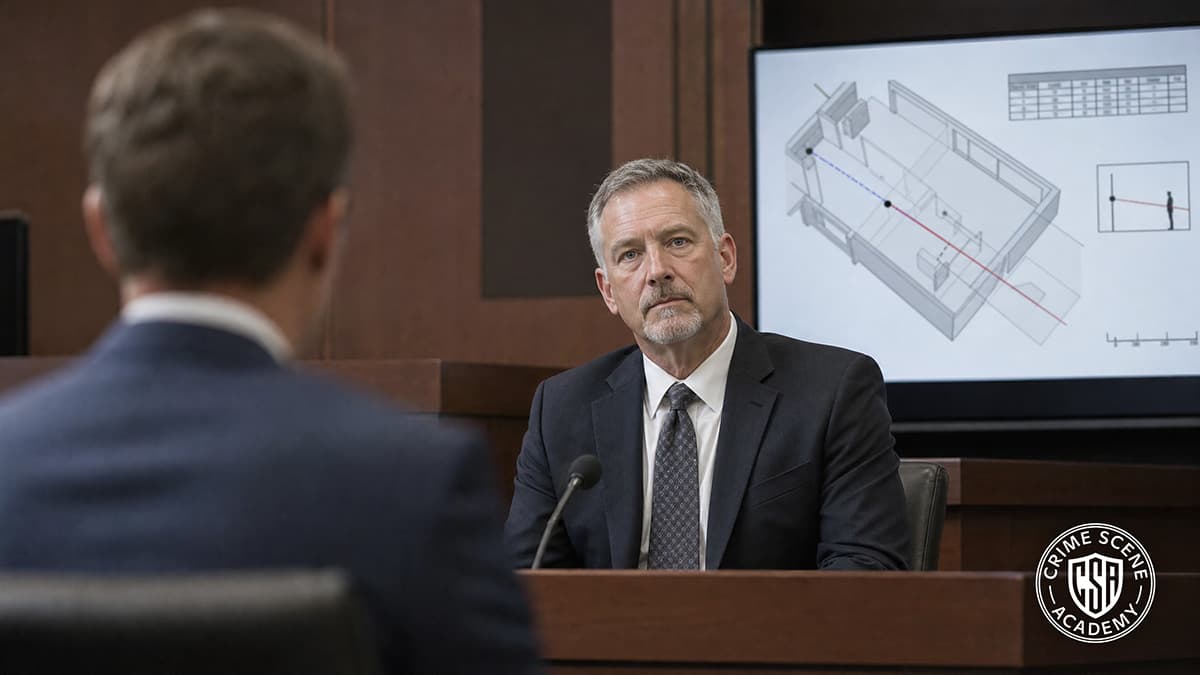
A reconstruction can be technically sound and still be taken too far.
An investigator may be able to establish a bullet's direction of travel, document defects, calculate a trajectory, evaluate physical evidence, and explain how those findings relate to one another.
But that does not mean every question about what happened has an answer.
That distinction matters in the report. It matters during case review. And it matters even more when the investigator takes the witness stand.
One of the most important skills an expert witness can develop is knowing where the evidence ends.
Being an Expert Doesn't Make Every Opinion an Expert Opinion
Expert witnesses are permitted to offer opinions because their specialized knowledge, skill, experience, training, or education may help a judge or jury understand evidence or determine a fact at issue.
But being qualified as an expert is only part of the equation.
An expert's testimony still needs an adequate factual basis. The principles and methods behind the analysis need to be reliable, and those methods need to be reliably applied to the facts of the case.
Extensive experience does not turn an unsupported conclusion into a supported one.
This is particularly important in shooting incident reconstruction because one finding can easily invite another conclusion.
A trajectory may tell you something about the path of a projectile. That does not automatically tell you exactly where a person was standing.
A defect may help establish directionality. That does not necessarily establish the sequence of every shot.
The physical evidence may be consistent with a particular scenario. That does not necessarily establish that it is the only way the event could have occurred.
The expert has to recognize those distinctions.
What Does the Evidence Actually Support?
A useful question throughout any reconstruction is:
What can I demonstrate from the physical evidence, and what am I assuming?
Consider a simplified example.
An investigator examines two bullet defects and uses appropriate reconstruction methods to establish a projected trajectory. That trajectory can be documented, measured, photographed, and explained.
Then comes the question:
Where was the shooter standing?
There may be enough evidence to describe an area or range consistent with the reconstructed trajectory. Additional evidence may help narrow the possibilities.
But if the available evidence does not establish an exact location, selecting a precise spot simply because someone wants one takes the conclusion beyond the evidence.
The same issue can arise when an investigator is asked:
- Which shot was fired first?
- Was the shooter standing or moving?
- What position was the victim in?
- How far away was the shooter?
- Did the shooter intentionally aim at a particular target?
- Is this exactly how the event happened?
Some cases provide evidence capable of answering some of those questions.
Others do not.
The expert's job is not to make the reconstruction more complete than the evidence allows.
Observation, Interpretation, and Assumption Are Not the Same Thing
One way to keep conclusions defensible is to separate three things clearly.
Observation is what you documented.
There is a defect in a particular location. A measurement has a particular value. A projectile was recovered from a particular area. A surface has particular physical characteristics.
Interpretation is what those observations support when appropriate principles and methods are applied.
The characteristics of a defect may support a direction of travel. Measurements may support a calculated angle. Multiple findings may support a reconstructed trajectory.
Assumption is something accepted or proposed without being independently established by the available evidence.
Assumptions are not automatically improper. Reconstruction sometimes requires investigators to evaluate scenarios based on stated conditions.
The problem occurs when an assumption quietly becomes a fact.
That transition can be difficult to see in a report—and very easy to expose during cross-examination.
“Consistent With” Is Not the Same as “Proves”
Language matters when communicating reconstruction findings.
Evidence can be consistent with a proposed scenario without establishing that scenario as the only possibility.
An expert may be asked whether the physical evidence supports a particular version of events. If it does, that can be explained.
But another question should follow:
Does the evidence exclude other reasonable possibilities?
If it does not, the testimony should not imply that it does.
Precision in language is not weakness. It tells the court exactly what the analysis can support.
The Pressure to Go One Step Further
Courtroom questions do not always stop at the natural boundary of the analysis.
An attorney may ask a reasonable question that simply cannot be answered from the available evidence. A hypothetical may introduce additional facts. A series of questions may gradually move from documented findings into increasingly speculative territory.
That is where discipline matters.
An expert does not have to manufacture certainty because a question has been asked.
Sometimes the most accurate answer is:
“I cannot determine that from the available evidence.”
Other times:
“The physical evidence is consistent with that possibility, but it does not establish it.”
Or:
“That conclusion would require assumptions beyond what I was able to determine from the physical evidence.”
The exact language depends on the case and the question. The underlying principle does not.
An expert's responsibility is to explain what the analysis supports—not to fill every unanswered space in the case.
Your Methodology Has Boundaries Too
Staying within the evidence is only one part of staying within your lane.
Every method has limits.
A technique may be appropriate for answering one question but incapable of answering another. Measurements contain uncertainty. Evidence can be incomplete. Scenes can be altered before documentation. Intermediate targets can complicate trajectories. Available physical evidence may support several possible configurations rather than one definitive reconstruction.
Those limitations should be understood before the investigator reaches the courtroom.
An expert who understands the boundaries of a method is better prepared to explain both what that method can establish and what it cannot.
That is part of defensible analysis.
Your Expertise Has Boundaries
There is another lane an expert needs to recognize: the boundary of the expert's own discipline.
A shooting reconstruction investigator may have substantial expertise in scene documentation, bullet defects, trajectory analysis, and reconstruction principles.
That expertise does not automatically extend to every related discipline.
Questions involving pathology, firearms and toolmark examination, engineering, toxicology, bloodstain pattern analysis, or other specialized areas may require expertise beyond the investigator's own qualifications.
Experienced investigators often know a great deal about adjacent disciplines. That knowledge can be valuable during an investigation.
But familiarity with a subject and qualification to offer a specialized expert opinion about it are not necessarily the same thing.
Knowing when another discipline should answer the question is part of being a credible expert.
Credibility Comes From Restraint
There can be a temptation to think that a strong expert witness should have an answer for every question.
Credibility is not built that way.
It comes from being able to explain what you did, why you did it, what evidence you relied upon, how you reached your conclusion, and what limitations apply.
It also means being willing to acknowledge when the evidence does not support an answer.
A reconstruction does not become stronger because the investigator sounds more certain.
It becomes stronger when the degree of certainty expressed is appropriate for the evidence and the method.
The Report Is Where This Starts
These boundaries should not appear for the first time on the witness stand.
They should be reflected in the reconstruction itself.
A report should make it possible to distinguish documented observations from analysis and conclusions. Important assumptions and limitations should be identifiable. Conclusions should be written at the level the evidence supports.
That matters because the report may eventually become the roadmap for testimony.
Months or years after a scene was processed, the investigator may be asked to explain not only what conclusion was reached, but how it was reached.
Clear documentation makes that explanation easier.
More importantly, it makes the analysis defensible.
Stay With What You Can Support
The goal of reconstruction is not to produce the most detailed possible story of an event.
It is to determine what can reasonably and defensibly be established from the available evidence using appropriate methods.
Sometimes that analysis can answer a great deal.
Sometimes it leaves important questions unresolved.
Both outcomes can represent good investigative work.
When the evidence supports a conclusion, explain it clearly.
When the evidence supports several possibilities, say so.
And when the evidence cannot answer the question, stay in your lane.
Sources and Further Reading
- Federal Rule of Evidence 702 — Testimony by Expert Witnesses
- National Institute of Justice — Law 101: Legal Guide for the Forensic Expert — Opinions and Conclusions
- National Institute of Justice — Law 101: Legal Guide for the Forensic Expert — Use of an Expert Witness at Trial
This article is intended for educational purposes and provides general information about expert testimony and investigative practice. Rules governing expert testimony and admissibility vary by jurisdiction. Investigators should follow applicable law, court rules, agency policy, and guidance from the attorneys handling their specific case.
Related training
Shooting Incident Analysis and Reconstruction
Crime Scene Academy’s Shooting Incident Analysis and Reconstruction course provides practical instruction in bullet defect analysis, trajectory reconstruction, documentation, and defensible analysis through clear animation, live demonstrations, chapter quizzes, and real-world case studies.
Explore the Course