

How Environmental Conditions Can Change an Outdoor Crime Scene
ArticleDocumentation & Analysis13 min read
Howard Ryan · August 25, 2026
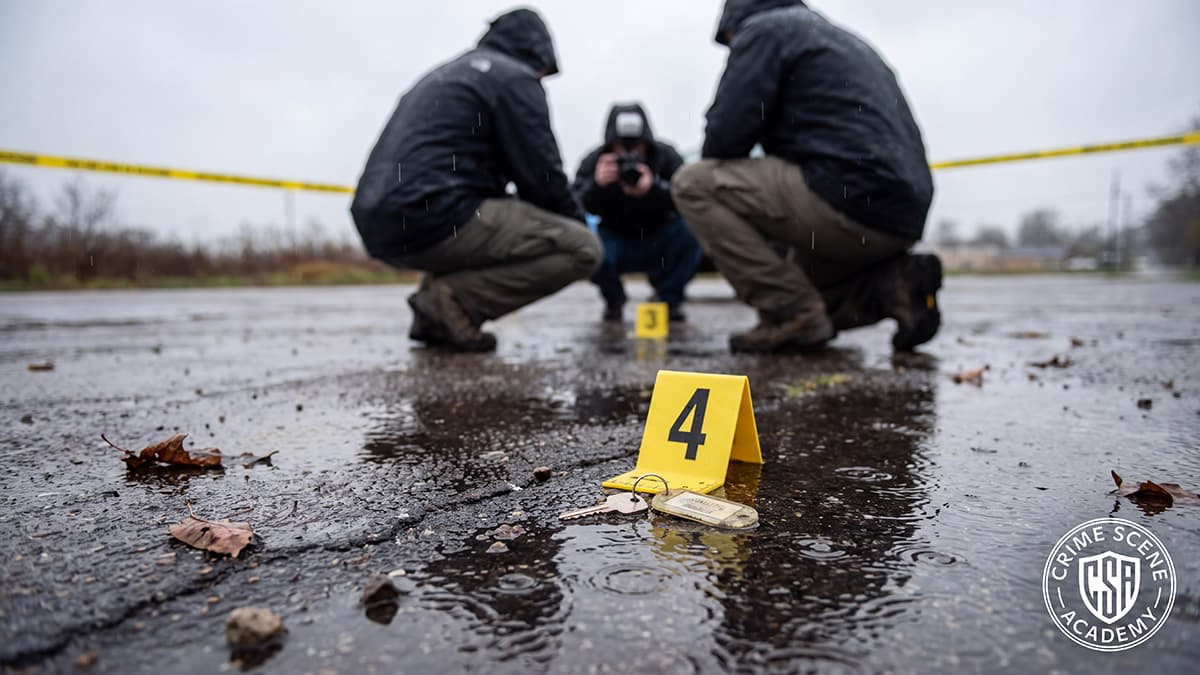
An outdoor crime scene does not remain static while investigators are on the way.
Rain may begin or stop. Temperatures rise and fall. Sunlight moves across the scene. Wind can disturb lightweight material. Snow and ice can accumulate, melt, or refreeze. The ground itself can change as soil becomes wet, dries out, or is disturbed by activity at the scene.
By the time investigators arrive, some of the conditions that existed when the incident occurred may already be different.
That makes the environment more than background information. It is part of understanding the scene.
Start With What Happened Before You Arrived
Documenting the current weather is important, but it only tells part of the story.
Investigators should also consider the environmental conditions between the incident and the examination of the scene. If an incident occurred several hours before discovery, the weather at the time of processing may be substantially different from the conditions during that interval.
Questions worth considering include:
- Did it rain after the incident?
- How much time passed before the scene was discovered?
- Was the area exposed to direct sunlight or shade?
- Did temperatures change significantly?
- Was there snow or ice on the ground, and did it melt or refreeze?
- Were there periods of strong wind?
- Did water drain through or collect in the scene?
- Could evidence have been moved, covered, diluted, degraded, or otherwise altered?
These questions do not establish what happened by themselves. They provide context for interpreting what investigators find.
Rain and Moisture
Rain is one of the most obvious concerns at an outdoor scene because it can begin changing conditions quickly.
Bloodstains provide a useful example. Research published in Forensic Science International examined diluted bloodstains and found characteristics that could help distinguish between blood deposited onto an already moist surface and a bloodstain that was deposited first and exposed to water afterward.
That distinction matters because moisture can change the appearance and distribution of a bloodstain. A stain examined after rainfall may not look the way it did when it was originally deposited.
Water can also move through a scene. On pavement, sloped ground, drainage areas, or uneven terrain, flowing water may affect the location and condition of exposed material.
For the investigator, the important question is not simply, "Is it raining?"
It is also, "What has this evidence been exposed to?"
Temperature, Humidity, and Sunlight
Environmental exposure can continue affecting biological evidence after deposition.
Research on bloodstain degradation has examined the effects of temperature, relative humidity, and light exposure. A 2026 study in Forensic Science International evaluated bloodstains aged under controlled combinations of temperature, humidity, and radiation. The researchers found measurable effects associated with those environmental variables when the stains were examined using several spectroscopic techniques.
The practical point is not that investigators should attempt to determine the age of a bloodstain from the weather. The study itself notes the uncertainty involved in translating controlled research to traces found at actual scenes.
Instead, the research reinforces a broader point: environmental history matters.
Evidence exposed to direct sunlight on a hot surface has experienced different conditions than evidence located nearby in shade or beneath vegetation. Temperature, humidity, light exposure, surface type, and elapsed time can all become relevant when considering how biological evidence may have changed.
Investigators do not need to become environmental scientists at every outdoor scene. They do need to recognize when exposure conditions may affect what they are observing.
The Ground Is Part of the Scene
Outdoor surfaces create another layer of complexity.
Evidence may be located on asphalt, concrete, sand, soil, grass, leaves, gravel, snow, or standing water. Each presents different challenges for recognition, documentation, and recovery.
A hard, dry surface behaves differently from wet soil. Vegetation can conceal small items. Mud can preserve impressions and then lose detail as conditions change. Leaves and other loose material can shift. Water may collect in low areas or travel downhill.
The surface itself may also change while investigators are working.
This is one reason early photography and documentation can be particularly important at an outdoor scene. Conditions observed at the beginning of processing may not remain unchanged throughout an extended investigation.
Wind and Movement
Not every piece of evidence is heavy enough to remain where it was deposited.
Paper, lightweight debris, loose vegetation, and other small material may be susceptible to wind or changing surface conditions. Even when a particular item has not moved, the material surrounding it may have.
That creates an important distinction between finding something at a location and establishing how it came to be there.
Investigators should be cautious about assuming that the position of lightweight material at the time of discovery necessarily represents its original position. Weather conditions, elapsed time, terrain, human activity, and other factors may need to be considered.
Snow and Ice Can Preserve and Obscure
Winter scenes present their own problems.
Snow can cover evidence that would otherwise be visible. Melting snow introduces water into the scene. Refreezing can change surfaces again. Footwear and tire impressions may deteriorate as temperatures rise, additional precipitation falls, or people move through the area.
At the same time, snow can preserve useful information. Impressions, disturbances, and other features may be visible precisely because snow was present.
The challenge is recognizing that those conditions are temporary.
A scene photographed while temperatures remain below freezing may look substantially different several hours later. Early documentation can preserve information about conditions that may no longer exist by the time processing is complete.
Outdoor Biological Evidence Has a Clock
Elapsed time matters.
A study published in Forensic Science International examined the detection and collection of blood and semen from outdoor scenes. The researchers specifically identified weather conditions, surface type, time, and specimen collection as factors investigators should consider.
Their experiments also demonstrated that the ability to obtain useful biological results changed with time and conditions.
That reinforces an important principle for scene processing. Recoverability is not determined only by whether evidence was originally present.
It can also depend on what happened to that evidence afterward.
Rain, moisture, temperature, the surface, and the passage of time can all become part of the history of the evidence.
Atmospheric Conditions and Shooting Scenes
Environmental conditions can also matter when evaluating projectile flight.
In external ballistics, a projectile moving through the atmosphere encounters air resistance. Air density, temperature, barometric pressure, humidity, and precipitation are among the variables that can affect drag and projectile behavior.
For many shooting scenes involving relatively short distances, investigators should not exaggerate these effects. Over longer distances, however, atmospheric conditions, gravity, velocity loss, projectile characteristics, and distance become increasingly relevant.
A projectile defect documented well away from the primary scene may also represent a bullet in the later portion of a much longer flight.
That can affect interpretation. A downward impact angle at a distant location does not necessarily establish that the firearm was positioned high above that location. The projectile may have traveled a substantial distance and entered the descending portion of its trajectory.
The physical evidence still matters. The point is that it must be interpreted within the conditions and distances involved.
Document Conditions, Then Think Beyond Them
Weather documentation should not become a box that gets checked and forgotten.
At an outdoor scene, investigators should consider documenting the environmental conditions relevant to the evidence they are examining. Depending on the scene, that may include precipitation, temperature, wind, ground conditions, sunlight or shade, standing water, snow, ice, or other significant features.
Historical conditions may also be important when there has been a delay between the incident and discovery.
Photographs taken early in the processing of the scene can establish conditions before investigators, weather, or time alter them further. Notes should describe environmental observations clearly enough that someone reviewing the case later can understand the conditions under which the evidence was found.
Most importantly, investigators should separate observation from interpretation.
An item was found in a particular location. A bloodstain had a particular appearance. An impression had a certain amount of detail. A projectile defect showed a particular orientation.
Those are observations.
Determining what those observations mean requires considering what may have happened before investigators arrived.
The Environment Is Part of the Evidence
Outdoor scenes require investigators to think in terms of change.
What were the conditions when the incident occurred?
What happened between the incident and discovery?
What changed before processing began?
What could have moved, degraded, diluted, melted, dried, become covered, or otherwise been altered?
Not every environmental factor will matter in every investigation. The goal is not to explain every piece of evidence through weather. It is to recognize when environmental exposure provides a reasonable factor that needs to be considered.
A crime scene is not frozen at the moment an incident ends.
Especially outdoors, it continues to change.
Understanding that change can lead to better documentation, more careful interpretation, and more defensible investigative conclusions.
Selected Research
Huard, L., Crispino, F., & Muehlethaler, C. (2026). Design of experiments (DOE) analysis of the effects of environmental conditions on bloodstain degradation using spectroscopic methods. Forensic Science International, 379, 112774. https://doi.org/10.1016/j.forsciint.2025.112774
van den Berge, M., de Vries, F. G., van der Scheer, M., Sijen, T., & Meijrink, L. (2019). Determining how diluted bloodstains were derived: Inferring distinctive characteristics and formulating a guideline. Forensic Science International, 302, 109918. https://doi.org/10.1016/j.forsciint.2019.109918
Skalleberg, A. G., & Bouzga, M. M. (2016). Detecting and collecting traces of semen and blood from outdoor crime scenes using crime scene dogs and presumptive tests. Forensic Science International, 264, 146-152. https://doi.org/10.1016/j.forsciint.2016.04.026
Related training
Shooting Incident Analysis and Reconstruction
For structured training on evidence documentation, scene analysis, and professional investigative practice, see the flagship course in the course catalog.
View Course Details