
What You See — and What You Don't
ArticleDocumentation & Analysis10 min read
Howard Ryan · May 20, 2026
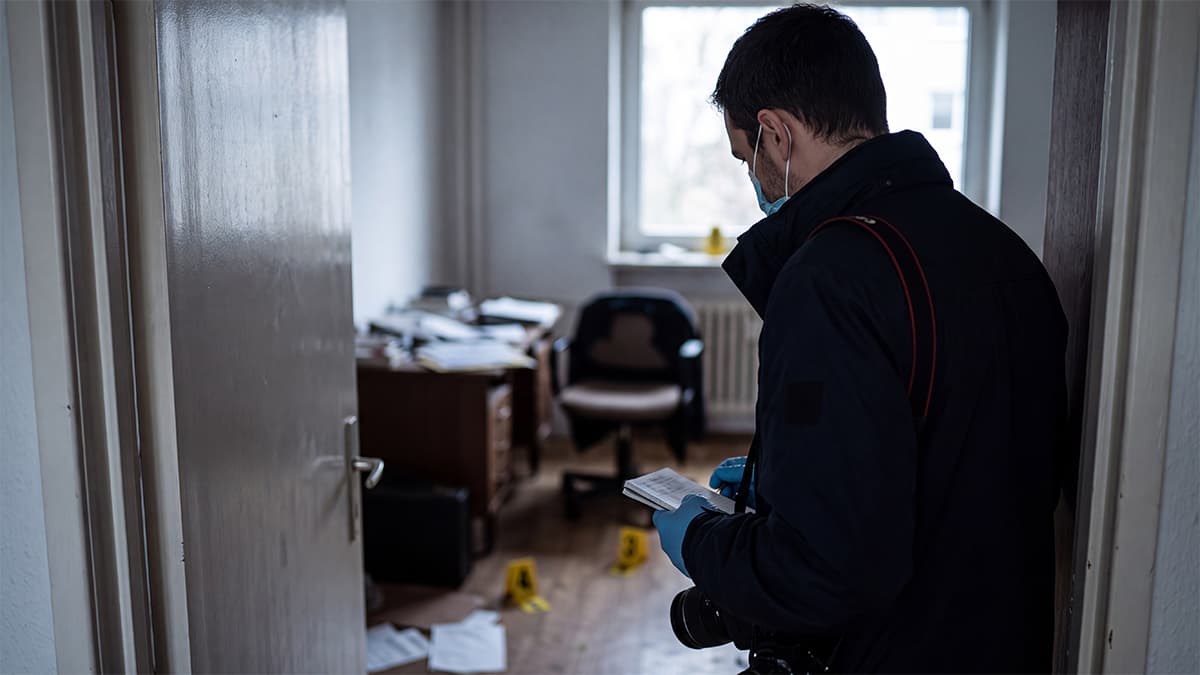
The moment a crime scene investigator crosses the threshold of a scene, the investigation has already begun. Before a single item is collected, before a photograph is taken, before a measurement is recorded, the investigator is doing what may be the most important thing they will do all day: looking.
Initial visual observation is the foundation for every subsequent decision. An experienced investigator scans the scene not only for what is present, but with equal care, for what is absent.
That distinction is more important than it may first appear.
Crime scenes are not static, unaltered environments frozen at the moment of the event. In many cases, they are environments that have been touched, manipulated, or deliberately altered by the individuals involved. Evidence may have been staged to mislead. It may have been hidden. It may have been destroyed.
The absence of evidence is itself a form of evidence.
A spent casing that should be present but is not. A weapon with no logical resting place. A surface wiped clean in an otherwise undisturbed environment. Recognizing that something is missing, and understanding why it should have been there, can be as investigatively significant as any recovered item. In some cases, it may be more significant.
The trained investigator does not simply catalog what the scene contains. They evaluate what the scene reveals about what it no longer holds.
Locating, Identifying, and Understanding Evidence
Once initial observations have been made, the investigator moves into the systematic process of locating, identifying, documenting, and securing items of potential evidentiary value. Each of these steps demands precision and discipline.
But running parallel to all of them, and too often underemphasized, is something less procedural and more analytical: understanding why each item matters.
This understanding is not a luxury. It is a professional necessity that directly shapes the quality and integrity of the investigation that follows.
An investigator who does not understand the significance of what they are collecting risks one of two outcomes: collecting too much or collecting too little.
Submitting every item encountered at a scene without evaluating its relevance can flood the laboratory with low-value submissions, consume limited forensic resources, and dilute the investigative focus. Conversely, overlooking an item whose significance is not immediately apparent can allow critical evidence to be lost permanently.
Understanding probative value requires the investigator to ask and answer several questions at the point of collection:
- Why is this item important? What role might it play in establishing the facts of the event?
- What additional evidentiary value might it provide? Beyond its obvious characteristics, what could this item reveal under further analysis?
- What type of analysis may be required? DNA profiling, fingerprint examination, ballistic comparison, trace evidence analysis, and digital forensics each carry different protocols, timelines, and preservation requirements.
- What path will this evidence travel within the laboratory? Understanding how evidence moves through the forensic system allows the investigator to collect, package, and submit it in a way that preserves potential analytical avenues and avoids inadvertently closing them off.
Your understanding of the probative value of a piece of evidence begins the moment you identify it. It does not end there. It travels with you through every phase of the investigation that follows.
The Laboratory Is Your Team
Once evidence has been collected and submitted, the investigator's relationship with that evidence enters a new phase. That phase is collaborative by nature and far more productive when treated that way.
Laboratory personnel are not separate from the investigation. They are an integral part of the investigative team, and they should be engaged as such.
When submitting evidence for analysis, the investigator should be prepared to communicate clearly and specifically: why the item was collected, what was observed at the scene that suggested its significance, and what questions the investigator needs the analysis to answer.
This is not a one-way transaction.
Laboratory professionals bring deep specialized expertise that the field investigator may not possess. Ask them what they see. Ask them what additional steps might be taken to draw more information from a piece of evidence. A skilled forensic analyst may identify analytical opportunities that were not apparent in the field.
That insight is available to you, but only if you ask for it.
The relationship between the crime scene investigator and the forensic laboratory is one of the most consequential partnerships in the investigative process. Treat it with the respect and intentionality it deserves.
From Findings to Report: Building the Bridge to the Courtroom
When laboratory analysis is complete and results have been received, the investigator enters the final critical phase of the evidentiary journey: the report.
The written report is not a formality. It is the vehicle by which everything the investigator observed, collected, analyzed, and concluded is carried into the courtroom.
This reality cannot be overstated: if it is not in your report, there is a very good chance you will not be permitted to speak to it in front of a jury.
An opposing attorney who identifies gaps between an investigator's testimony and their written report has a procedural avenue to challenge that testimony. Months or years of investigative work, a significant piece of forensic analysis, or a critical observation made on the day of the scene can be weakened or excluded because it was not documented in the report.
The report must therefore be thorough, accurate, and reflective of what the investigator observed and concluded. It must capture not only what was done, but also why it was done, including the reasoning and significance behind decisions made in the field and findings that followed.
This is where probative value, understood from the first moment at the scene, finds its formal expression.
The Full Arc: Scene to Stand
The concept of probative value is not a checklist item to be completed and set aside. It is a through-line that connects every phase of the investigative process from beginning to end.
It begins the moment the investigator walks into the scene and starts observing. It shapes decisions about what to collect, how to collect it, and how to preserve it. It informs the conversation with laboratory personnel about what questions need to be answered. It structures the written report that carries the investigation's findings into the legal arena. And it reaches its final expression when the investigator takes the witness stand and explains what they found, what it meant, and why it matters.
Every step of that journey is connected.
Understanding the probative value of evidence is what holds those steps together. It is what separates a thorough, defensible investigation from one that may not survive scrutiny.
Walk into every scene with that understanding already in hand, and carry it with you all the way to the end.
Crime Scene Academy provides professional online training for real-world investigations.
Related training
Shooting Incident Analysis and Reconstruction
For structured training on evidence evaluation, documentation, and professional investigative practice, see the flagship course in the course catalog.
View Course Details