
Through the Lens: The Critical Role of Photography in Crime Scene Investigation
ArticleDocumentation & Analysis11 min read
Howard Ryan · May 13, 2026
The Camera as a Core Competency
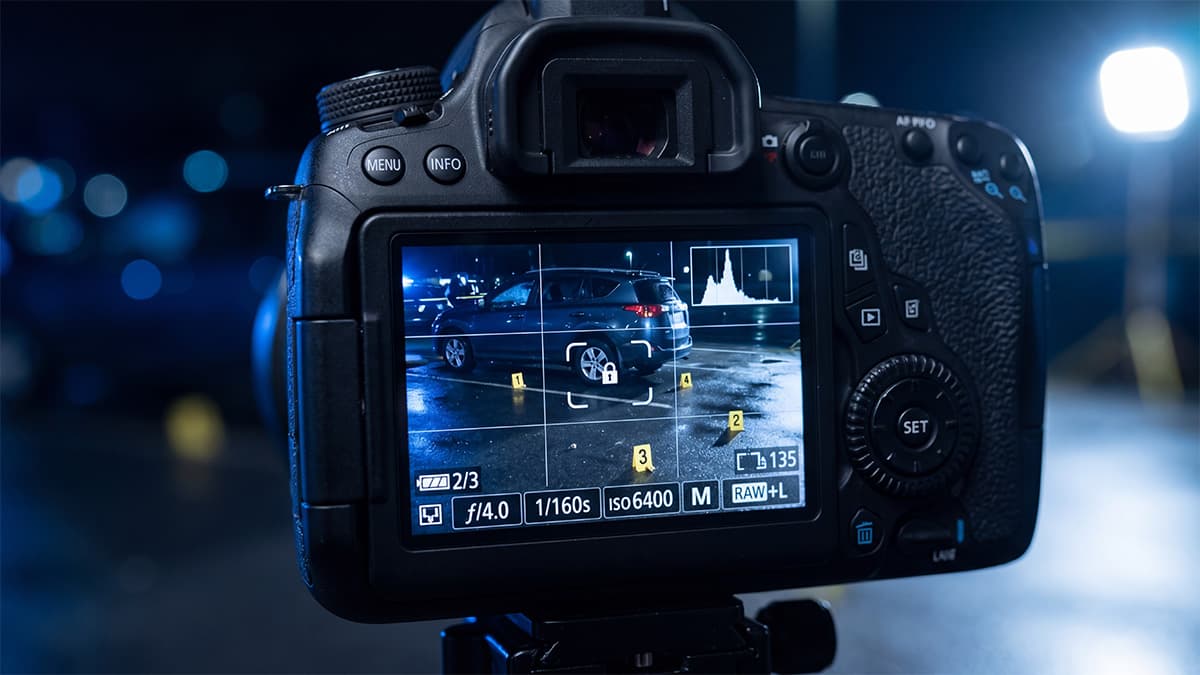
Of all the tools a crime scene investigator carries into the field, none is more fundamental or more frequently used than the camera. From a routine burglary to a complex homicide, the camera is present at every scene, in every discipline, and at every stage of the investigation. No other single piece of equipment comes close to matching the frequency with which it is deployed. It is not an accessory to the job. It is, in many respects, central to the job itself.
For this reason, developing strong photographic skills is not optional. An investigator may possess deep technical knowledge, but if they cannot effectively photograph what they observe, that knowledge remains trapped in memory. It becomes inaccessible to prosecutors, defense attorneys, judges, and jurors who were not present at the scene. Photographic competency is therefore a foundational professional obligation, not a supplemental skill.
Documentation-Quality Photography: Capturing the Scene in Context
Crime scene photography operates on two distinct levels, each serving a different investigative and evidentiary purpose. The first is documentation-quality photography.
Documentation-quality photographs focus on the broad view. These images establish the spatial geography of the scene: where the scene is located, what it looks like in its entirety, and how individual items of evidentiary value relate to one another and to the environment around them. A documentation-quality photograph might capture an entire room, a stretch of roadway, or the exterior of a structure. The goal is to answer the question: Where is everything, and how does it relate to everything else?
These photographs serve as the visual foundation of the investigation. They allow a viewer, whether a fellow investigator, an attorney, or a juror, to orient themselves within the scene before examining its details. Without strong documentation photography, the context in which evidence was found may be lost entirely. When that context is lost, the narrative that evidence is meant to support or refute may be weakened as well.
Examination-Quality Photography: The Detail That Tells the Story
The second level is examination-quality photography, and it demands a fundamentally different approach. Where documentation photography steps back, examination photography moves in close. Its purpose is to record the individual characteristics of a specific item of evidence in a way that fully captures what the investigator observed firsthand.
Examples of evidence that require examination-quality photography include:
- Lead-in marks: striations or impressions in a surface created by a projectile’s path of entry, which can indicate trajectory and assist with determining the angle of impact.
- Bullet wipe: the ring of residue deposited around an entry wound or impact site, which can indicate an initial impact point.
- Conchoidal and radial fractures: characteristic fracture lines through glass, which can reveal the direction of force and, in some cases, the sequence of multiple impacts.
These are not details that can be adequately captured in a wide-angle establishing shot. They require deliberate composition, appropriate lighting, scale markers, and technical precision. A poorly photographed piece of trace evidence may be rendered meaningless in court, regardless of how significant it was to the investigator at the scene.
This is the critical principle underlying examination photography: the camera is the extension of what the crime scene investigator sees. When an investigator leans in to observe a fracture pattern or a contact wound, that visual experience belongs to them alone unless the camera captures it. The camera transforms a private observation into a permanent, transferable record. It documents the investigator’s point of view and places the jury in the investigator’s shoes. Every frame taken with intention and care is a frame that a jury can examine, question, and ultimately understand.
Photographing the Area Immediately Surrounding the Body
In scenes involving a deceased victim, no area commands more photographic attention or carries greater evidentiary weight than the area immediately surrounding the body. This is where the story of the event often begins to take shape, and where the consequences of inadequate documentation are most severe.
Bloodstain Evidence: Presence and Absence
Among the most significant items of evidence in the area immediately surrounding the body is bloodstain evidence. Critically, both its presence and its absence may be meaningful. The pattern, distribution, volume, and type of bloodstain evidence can provide investigators with important insight into the events that preceded, accompanied, and followed the death of the victim.
Bloodstain analysis may reveal whether the victim moved or was moved before, during, or after the fatal event. Pooling patterns may indicate that the body remained stationary for an extended period. Cast-off patterns, transfer stains, and voids in bloodstain distribution can each tell a part of the story. The absence of bloodstain evidence where it would be expected can be just as informative as its presence, potentially indicating that a secondary location was involved or that the scene was altered.
Thorough photographic documentation of all bloodstain evidence — its shape, size, location, and relationship to the body — is essential to any subsequent analysis.
Additional Physical Evidence On and Around the Body
Beyond bloodstain evidence, the area surrounding the body may contain a range of physical evidence of critical importance: trace materials, impression evidence, foreign objects, or items that may have been in the possession of the victim at the time of death. Each must be carefully documented in both context and detail before any collection or disturbance occurs.
The Risk of Interruption: Protecting the Photographic Opportunity
There is a practical reality of homicide scene investigation that every crime scene investigator must be prepared to manage: the area around the body draws people. Medical examiner staff, detectives, supervisors, and command personnel will all, at various points, feel the need to be present in close proximity to the body. This convergence is often unavoidable and is, most of the time, driven by legitimate professional necessity.
However, this concentration of personnel creates a significant risk. In the movement and activity that surrounds the initial examination of a decedent, evidence in the immediate area can be disturbed, displaced, or overlooked. The systematic, methodical approach that is the hallmark of sound crime scene investigation may be disrupted, sometimes significantly, by the sheer number of people working the scene simultaneously.
The single most effective measure an investigator can take to protect against this risk is straightforward: begin the photographic examination of the body before any other examination of the body has begun. Photograph the body and its immediate surroundings completely, in context, in detail, and from multiple angles and perspectives before the medical examiner conducts an external examination, before evidence collection begins, and before the area is populated with additional personnel. Once the scene has been disturbed, the opportunity to capture an undisturbed image of what was there is gone forever.
This is not a procedural formality. It is the protection of the record.
The Camera Cannot Be Replaced
As technology evolves, laser scanning and three-dimensional photogrammetry have become increasingly available to crime scene units. These tools offer genuine value in capturing spatial data and scene geometry with remarkable precision. They are legitimate additions to the investigator’s toolkit.
They are not, however, replacements for the camera.
Laser scanning captures dimension and distance. It does not capture the investigator’s eye. It does not frame a piece of evidence the way a trained human observer frames it, with awareness of what is significant and why. It does not bring a jury into close visual contact with the texture of a wound, the characteristics of a fracture pattern, or the subtle distribution of a bloodstain.
The camera remains the irreplaceable extension of the crime scene investigator’s point of view. It is the instrument through which an investigator’s trained observations are preserved, shared, challenged, and ultimately trusted. No technology that measures the world from a distance can replicate the act of a skilled investigator deciding what matters, moving toward it, and making certain that what they see becomes what others can see.
That decision, and that skill, belongs to the photographer behind the camera.
Related training
Shooting Incident Analysis and Reconstruction
For structured training on evidence documentation, scene photography, and professional investigative practice, see the flagship course in the course catalog.
View Course Details