

Why Angle of Impact Matters in a Shooting Investigation
ArticleShooting Reconstruction9 min read
Howard Ryan · May 6, 2026
A bullet defect is not just a hole in a surface.
When properly documented and analyzed, a bullet defect may help investigators understand the direction a projectile was traveling when it struck a target. That information can become important when evaluating possible shooter position, target position, bullet path, and the overall sequence of events.
One of the key concepts in this process is the angle of impact, also called the angle of incidence.
What is angle of impact?
The angle of impact is the angle formed between the path of the projectile and the surface it strikes.
In shooting incident reconstruction, angle of impact is generally evaluated in two parts: the horizontal angle and the vertical angle.
The horizontal angle helps describe whether the projectile was traveling left to right, right to left, front to back, or back to front when it struck the surface.
The vertical angle helps describe whether the projectile was traveling upward, downward, or nearly level at the moment of impact.
A complete angle of impact determination requires both components. It is not enough to simply say that a bullet traveled “downward” or “from left to right.” Investigators need to document the approximate degree measurement and the directionality associated with that measurement.
For example, a complete description might include a horizontal angle of approximately 31 degrees right to left and a vertical angle of approximately 4 degrees down.
Why does it matter?
Angle of impact can help investigators begin to evaluate the possible flight path of a projectile through a scene.
When a bullet strikes a wall, vehicle, floor, ceiling, piece of furniture, or other target surface, the defect it leaves behind may contain information about the projectile’s direction of travel. When that defect is properly documented, measured, photographed, and interpreted, it can help answer important investigative questions.
Where was the projectile coming from?
Was it traveling upward or downward?
Did it pass through more than one surface?
Does the physical evidence support the proposed sequence of events?
Could the target object have moved before, during, or after the shooting?
Could an intermediate target have altered the projectile’s path?
These are not minor details. They can influence how investigators understand the incident, how findings are documented in reports, and how conclusions are explained later in court.
The role of measurement tools
In practical reconstruction work, tools such as trajectory rods, protractors, angle finders, scales, strings, and reference markers may be used to document and evaluate bullet defects.
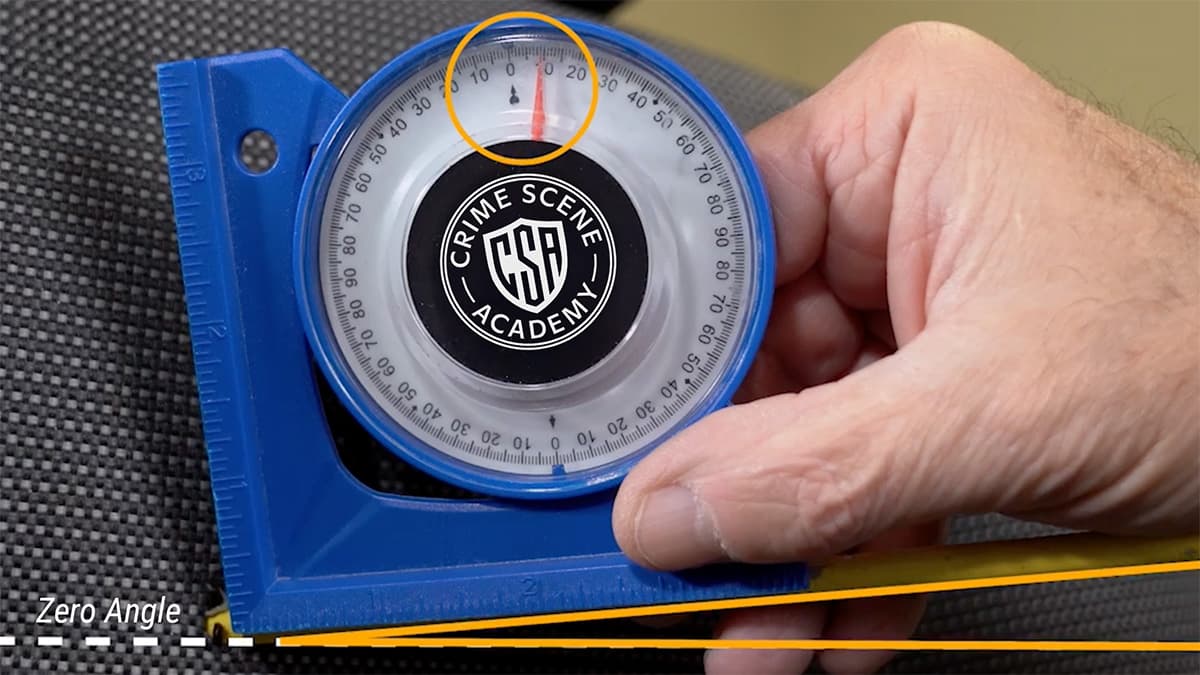
An angle finder is commonly used to help determine the vertical component of the angle of impact. This can help show whether the projectile was traveling upward, downward, or close to level when it struck the target surface.
A protractor may be used to help determine the horizontal component. Together, these measurements can help investigators describe the projectile’s path more completely.
However, the tools do not make the conclusion by themselves.
The investigator still has to determine whether the defect is suitable for analysis, whether there are reliable features present, whether the target surface moved, whether there are corresponding defects, and whether the physical evidence supports the interpretation.
Not every defect gives a clear answer
Angle of impact analysis requires caution.
Not every bullet defect is clear enough to support a reliable angle determination. Surface material, bullet deformation, destabilization, ricochet, intermediate targets, and movement of the target object can all affect the evidence left behind.
A bullet that strikes drywall may leave a different type of defect than one that strikes auto body metal, glass, wood, fabric, or bone. A projectile that has already passed through another surface may be damaged, unstable, or redirected before it reaches the next target. A movable object, such as a vehicle door, seat, cabinet door, or piece of furniture, may have changed position after the shot was fired.
If those possibilities are not considered, an angle measurement may appear more certain than it actually is.
That is why angle of impact should never be treated as guesswork or as a standalone answer. It must be interpreted in context.
Documentation is critical
Before any meaningful analysis can occur, the defect must be properly documented.
Investigators should describe the general appearance and features of the defect, determine whether there are visible indicators such as a leading edge or bullet wipe, measure the defect’s location and position, photograph it with and without scales, and record the measurements clearly in notes or worksheets.
The location and position of the defect matter. So does the condition of the target surface. So does the relationship between that defect and any corresponding defects, recovered projectiles, fragments, or other evidence in the scene.
Once a surface is moved, altered, repaired, cleaned, or destroyed, the opportunity to document that information may be lost.
The goal is responsible interpretation
Angle of impact can be a powerful part of shooting incident reconstruction, but it has to be used responsibly.
The goal is not simply to place a rod in a hole or record a number from an angle finder.
The goal is to understand what the physical evidence can reliably tell you about the shooting event, while also recognizing what it cannot tell you.
A well-supported reconstruction depends on careful observation, proper documentation, sound methodology, and an honest understanding of the limitations of the evidence.
When done correctly, angle of impact analysis can help investigators move beyond simply identifying bullet defects. It can help them evaluate directionality, possible flight paths, target movement, intermediate impacts, and the relationship between the physical evidence and the reported sequence of events.
In shooting incident reconstruction, the angle matters.
But the context matters just as much.
Related training
Shooting Incident Analysis and Reconstruction
For applied training on angle of impact, bullet defect documentation, and shooting reconstruction methodology, see the flagship course in the course catalog.
View Course Details