
Probative Value: Knowing What Matters at the Crime Scene
ArticleDocumentation & Analysis11 min read
Howard Ryan · October 1, 2026
Every crime scene asks the same question of the person processing it: What here actually matters?
The answer isn't found in a checklist. It comes from the investigator's understanding of probative value, which is the ability of a piece of evidence to prove or disprove a disputed fact.
The decisions you make when you walk under the yellow tape, including what to photograph, what to swab, what to bag, and what to leave, may eventually be tested in a courtroom. Understanding probative value helps you make those decisions with purpose.
What “Probative Value” Really Means
In legal proceedings, probative value describes how much a piece of evidence helps establish a fact that matters to the case. It is closely connected to questions of relevance, reliability, and ultimately whether and how the evidence may be considered in court.
Evidence with high probative value can contribute significantly to establishing or challenging a disputed fact. Evidence with little probative value may add very little to the questions the court is being asked to decide.
A single well-documented bloodstain can tell investigators more than a dozen loosely connected items collected “just in case.”
For the investigator, this is not an abstract legal concept. Probative value starts at the scene. Evidence that is poorly documented, contaminated, or collected without its context can lose much of its value before an attorney ever sees it.
The Balancing Test: Value vs. Prejudice
Probative value is not always considered in isolation. Under Federal Rule of Evidence 403 and similar state rules, courts may exclude relevant evidence when its probative value is substantially outweighed by concerns such as unfair prejudice, confusing the issues, or misleading the jury.
That is one reason context matters.
A graphic photograph with no clear connection to a disputed fact may face a different admissibility question than a photograph that documents something important about the position of the victim, the direction of an attack, or another fact at issue.
What you document at the scene can affect how clearly the significance of that evidence can later be explained.
Beyond “Whose Is It?”: Activity-Level Propositions
Probative value becomes especially important when we move beyond simply identifying the source of a piece of evidence.
Knowing that DNA belongs to a particular person answers a source-level question: Whose DNA is it?
It does not necessarily tell us how the DNA got there, when it was deposited, or what activity caused it to be present.
That is where activity-level propositions become important.
Instead of stopping at identification, activity-level thinking asks what actions or events could explain the evidence. The question shifts from “Who does this evidence belong to?” to “What actions led to this evidence being present?”
For the crime scene investigator, that distinction matters because much of the information needed to evaluate those competing explanations may exist only at the scene. Once that context is lost, it may be impossible to recover.
Five Lenses for Reading a Scene
Nature of activities. Consider the actions people may have taken and the events that unfolded. How did the blood, fingerprints, fibers, or other evidence come to be where you found them? Was it direct contact, secondary transfer, or something that occurred before the crime?
Hypothesis formulation. Investigators should consider more than one possible explanation for the evidence. “The defendant stabbed the victim” is one proposition. “An unknown person stabbed the victim” is another. Good scene work preserves and collects what is needed to evaluate competing explanations rather than only the one that initially seems obvious.
Contextual circumstances. Location, timeframe, environmental conditions, and interactions between the people involved can all affect how evidence should be interpreted. Those circumstances provide the context needed to evaluate whether a proposition is consistent with what was observed.
Comparative analysis. Evidence can be evaluated against competing propositions to determine how well the observed findings fit each explanation. The goal is not simply to find evidence that supports one narrative, but to understand what the evidence can and cannot tell you.
Legal implications. Prosecutors and defense attorneys may ultimately present different explanations for the same evidence. Clear documentation gives the court a better foundation for understanding those competing positions and the evidence behind them.
Field Scenario: The Doorframe Bloodstain
A victim is found stabbed in a kitchen. The defendant lives next door and admits he visited the home that afternoon. A small bloodstain on the kitchen doorframe is later matched to him.
At the source level, the finding is straightforward: the blood is his.
At the activity level, the question is harder.
Did he bleed while committing the attack? Or did he cut his hand earlier in the day on a broken glass, as he claims?
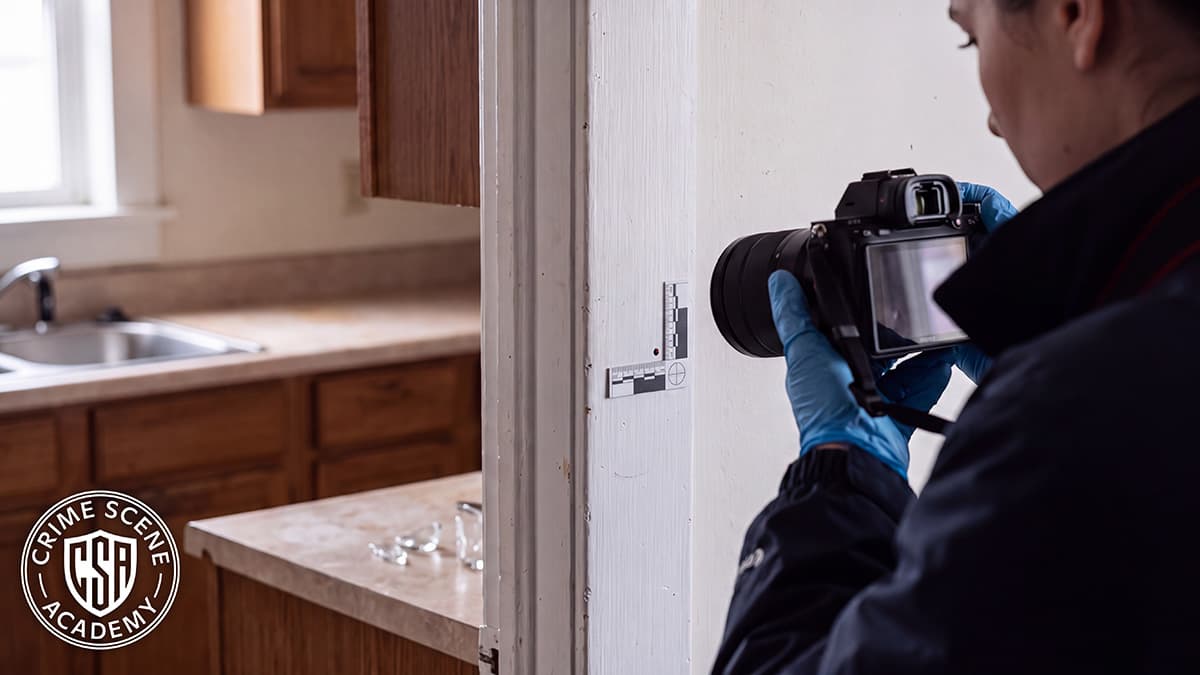
The investigator who photographed the stain in place, recorded its height and shape, noted the broken glass in the sink, and collected a sample from it has preserved information that can help evaluate both explanations.
The investigator who simply swabbed the doorframe has not.
Same stain. Same laboratory result. Very different probative value.
The difference was made at the scene.
At the Scene: Collection Decisions That Hold Up in Court
Before you collect an item, ask yourself what it could help prove or disprove, and how it relates to the competing explanations that may eventually need to be evaluated.
Then let a few basic habits guide your work:
- Know the questions in dispute. Collect with likely competing explanations in mind, not only the one that seems obvious.
- Document before you disturb. Position, orientation, condition, and relationship to other items are often where activity-level value lives.
- Capture the context. Record timeframe indicators, environmental conditions, and possible innocent sources of transfer when they are relevant.
- Protect reliability. Proper packaging, contamination control, and an unbroken chain of custody help preserve the evidentiary value of what you collect.
- Explain your reasoning. When appropriate, document why an item was collected and what investigative question it may help answer.
The Bottom Line
The value of evidence is not limited to what a laboratory can identify.
Where an item was found, its condition, its relationship to the surrounding scene, and the circumstances that may explain how it got there can be just as important as the laboratory result itself.
That context starts disappearing the moment a scene is disturbed.
Understanding probative value helps investigators recognize what needs to be preserved before that happens. It encourages you to look beyond simply collecting evidence and ask a more useful question:
What can this evidence actually tell us about what happened?
An investigator who understands probative value doesn't just collect evidence.
They collect answers.
Related training
Shooting Incident Analysis and Reconstruction
For structured training on evidence documentation, scene analysis, and professional investigative practice, see the flagship course in the course catalog.
View Course Details