
The First Five Minutes: How a Failure to Secure the Scene Can Unravel a Case
ArticleDocumentation & Analysis11 min read
Jim Molinaro · July 23, 2026
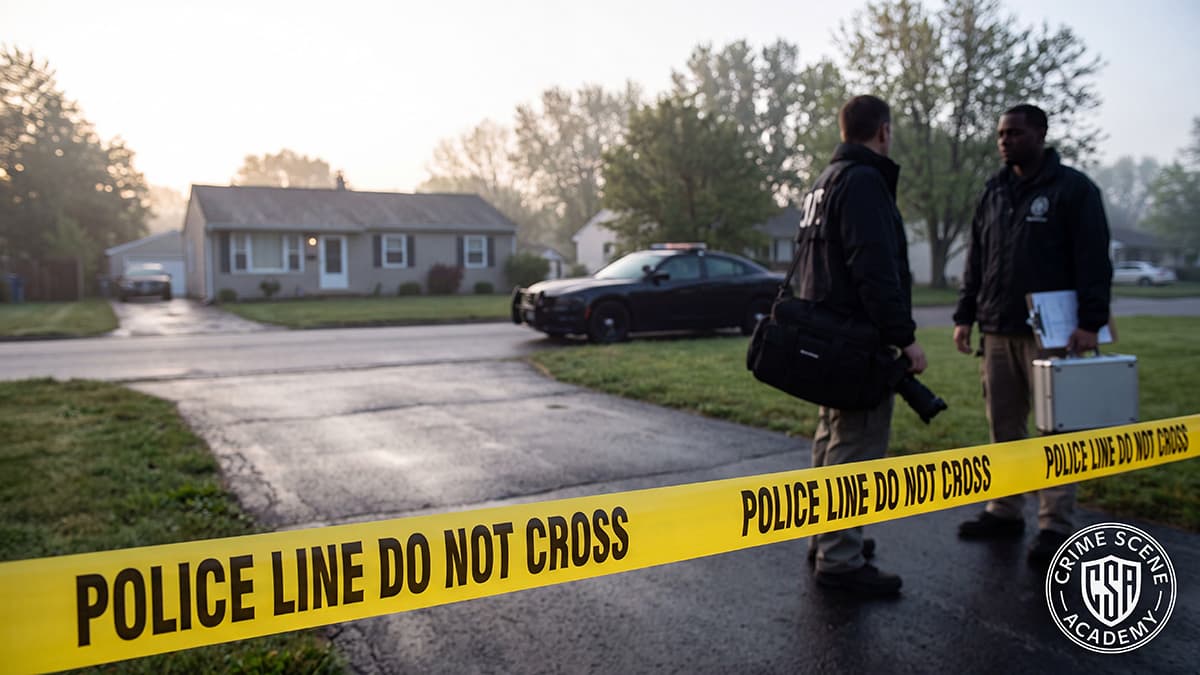
There's a moment at the start of every scene that determines everything that follows, before the tape goes up, before the entry/exit log starts, before anyone puts on gloves. It's the moment the perimeter either holds, or it doesn't. Get it right, and everything downstream, the photographs, the evidence collection, the reconstruction, the testimony, stands on solid ground. Get it wrong, and no amount of skill at the scene, in the laboratory, or on the witness stand can fully repair the damage.
Scene security isn't an exciting part of the job. It doesn't show up in the true-crime documentary reenactments. But it is, without exaggeration, the single point of failure that has done more to sink crime scene work, prosecutions, and free the guilty than almost any other investigative mistake.
The Data Behind the Danger
This isn't just an old CSI hand's opinion. In 2009, the National Academy of Sciences released Strengthening Forensic Science in the United States: A Path Forward, a congressionally mandated review that found significant problems with the reliability of many forensic science disciplines used in criminal courts. Among its core findings, the committee concluded that courts had been admitting testimony that overstated what the underlying science could accurately demonstrate. This problem often starts at the scene itself, where poor documentation, uncontrolled access, and contamination compromise the evidence everything else depends on.
The scale of the downstream damage shows up in the numbers. A 2023 review of cases in the National Registry of Exonerations found forensic evidence errors in 635 of 732 cases studied, nearly 87 percent. Dr. John Morgan, working under an NIJ grant, pulled 732 cases from the NRE that had already been classified by the registry as involving "False or Misleading Forensic Evidence," covering 44 states and the District of Columbia. Of those 732 cases, 635 were found to include a case error associated with forensic evidence, while 97 did not. The 732-case pool was pre-selected by NRE as forensic evidence-related cases, not a random or representative sample of all exonerations. So, 87% describes error prevalence within a forensic-flagged subset, not the whole exoneration landscape. While these cases were already identified as involving forensic evidence issues, the findings underscore how frequently evidence-related errors can become central to wrongful convictions.
Case Studies: When the Scene Fails, the Case Follows
JonBenét Ramsey: Boulder, Colorado (1996)
Few cases illustrate the cost of an unsecured scene as starkly as this one. Responding officers failed to secure the scene in the hours following the child's disappearance, and the home was contaminated as a result. Family friends and even the family's pastor came and went freely through the house, walking through rooms and even tidying up before the body was found. Boulder's own former police chief later admitted in a public interview that the scene should have been secured and controlled far more tightly on day one, acknowledging that the failure may have contributed to the case never producing enough admissible evidence to bring anyone to trial. Almost thirty years later, it remains unsolved, a lasting reminder that "no charges" can be as damaging an outcome as an acquittal.
Amanda Knox and Raffaele Sollecito: Perugia, Italy (2007)
Investigators entering the victim's room did so without proper protective clothing, and video footage later showed items at the scene being moved, potentially creating new bloodstains and further compromising the evidence. A bra clasp central to the prosecution's DNA case wasn't collected until weeks after the initial search, after it had been handled by multiple investigators. Independent forensic reviewers later concluded there was a possibility the clasp had been contaminated during the weeks it sat exposed at the scene. Knox's murder conviction was ultimately overturned; contamination of the physical evidence was central to the appeal.
People v. O.J. Simpson: Los Angeles, California (1995)
Whatever one believes about the underlying facts, the trial became a national case study in chain-of-custody failure. Questions about how blood evidence was collected, stored, and transported by investigators gave the defense an opening that helped produce one of the most famous acquittals in American history. The case demonstrated that even compelling biological evidence can lose credibility when investigators cannot clearly explain how it was collected, documented, stored, and transferred from the scene to the courtroom.
The Common Thread
Strip away the headlines and every one of these cases shares the same structural failure: someone, somewhere, treated the perimeter, physical or procedural, as optional. A door left open to well-meaning friends. A room entered without protective gear. A swab collected weeks late. An item of evidence not logged in for days. None of these investigators set out to destroy a case. But neither intent nor good faith restores contaminated evidence or repairs a broken chain of custody once a defense attorney identifies the gap.
What This Means for the Investigator on Scene
For those of us who've stood at that first perimeter, the lesson isn't abstract. It's a checklist we should never let ourselves get casual about:
- Establish control before anyone, including brass, family, or "just looking" bystanders, crosses the line. The first officer's authority over the scene is not a courtesy; it's a legal necessity.
- Log every single entry and exit, no matter how brief or well-intentioned the visit.
- Document before you touch. Photographs, scans, and notes made before collection are often the only record of the scene's original condition.
- Treat delay as contamination's best friend. Evidence sitting uncollected, unsecured, or unlogged is evidence a defense expert will eventually question, and rightly so.
- Remember that chain of custody doesn't end at the scene tape. It follows the evidence through transport, storage, and testing, and it only takes one undocumented gap to unravel it in court.
The forensic science and courtroom testimony that make headlines are built on a foundation most people never see: the perimeter, the log, the first five minutes. Protect that foundation, and every examination that follows stands on firmer ground. Fail to protect it, and no laboratory can restore what was lost during those first five minutes.
References
- National Research Council. Strengthening Forensic Science in the United States: A Path Forward. National Academies Press, 2009.
- Morgan, John. "Wrongful Convictions and Claims of False or Misleading Forensic Evidence." Journal of Forensic Sciences, March 2023. National Institute of Justice.
- National Institute of Justice. "The Impact of False or Misleading Forensic Evidence on Wrongful Convictions." November 28, 2023.
- National Registry of Exonerations.
This article is provided for educational purposes by Crime Scene Academy.
Related training
Shooting Incident Analysis and Reconstruction
For structured training on documentation, evidence evaluation, and professional investigative practice, see the flagship course in the course catalog.
View Course Details